
Natural Assurance Schemes (NAS) canvas and successful business model examples
Description
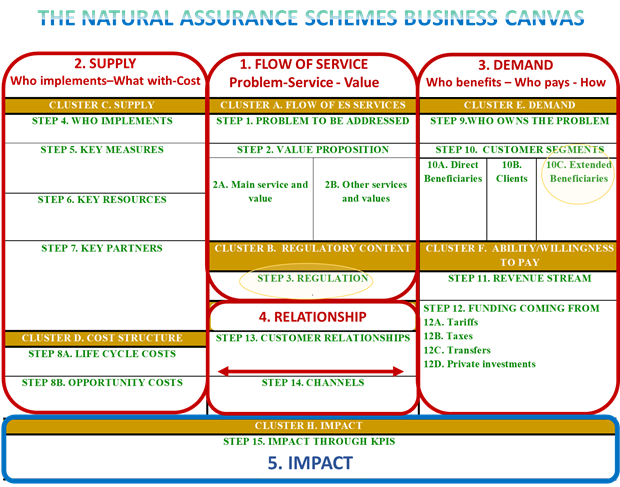
Business models have been traditionally described using the business model canvas, which is a frame aimed at helping a business to identify all the elements required to successfully create and deliver a certain value (usually through the commercialization of a product or service) and obtain a profit out of it. However, the provision of natural services or goods (in this case through NBS interventions) has some particularities as compared to regular products or services. These are mainly linked to their capacity to provide public good services or functions with intangible values, their high dependency on the regulatory context, effects and values are seen in the long term whereas the investment is required upfront, among others. To account for these differences, NAIAD has developed an adapted version of the business canvas tailored for the analysis and description of business models for NBS, which includes elements from the Business Hub extended canvas and NAIAD’s economic framework. This so called NAS canvas (or Natural Assurance Scheme canvas) reflects the flow of services generated by NBS and how their value is captured in both the supply and the demand side of service provision, and describes the elements required in this process, thus providing the key ingredients for the creation of one or several business models around it. This canvas is applied to describe examples of successful business models to fund and implement NBS reported worldwide (compiled in D7.2), as well as to identify the ingredients for viable business models for NBS strategies in NAIAD demos (reported in NAIAD D.7.4).
Applications to decision making in the insurance sector:
The canvas gathers information on the value proposition (damage cost reduction potential) and potential beneficiaries. Therefore, it can help the insurance sector to dimension the effects and costs of such intervention and realize and assess their potential interest in playing a role, and which role (investors, beneficiaries, …), in promoting its implementation.
Added value of this modelling approach/model/results:
It builds the bridge between the results of the economic valuation and the communication to the investment sector by gathering in a visually friendly manner the ingredients for viable business models that can tap the value created by the NBS and be effectively implemented.
What decision can be improved with this modelling approach:
Investment decisions, engagement decisions

Potential Categories of Users
Water planners
Regional government
Entrepreneurs
Private sector
Additional Links
Mayor, B., López Gunn, E., Zorrilla, P., Nanu, F., Groza, I., Schrieu, A., Marchal, R., Le Coent, P., Graveline, N., Piton, G., Biffin, T., Daartée, K., Pengal, P., Krauze, K., Douglas, C., van der Keur, P., Jørgensen, M.E., Calatrava, J. and Manzano, M. (2019) Deliverable 7.2: From Bankability to Suitability report: value capture and business models to catalyse implementation of NAIAD demo’s NAS strategies. H2020 NAIAD project. Grant Agreement No 730497.
../../../wp-content/uploads/2020/07/D7.2.pdf
Mayor, B., Benítez, C., Angulo, M., Nanu, F., Groza, I., Schrieu, A., Marchal, M., Le Coent, P., Graveline, N., Marouner, A., Matthews, J., Altamirano, M.A., López Gunn, E. (2019) Deliverable 7.4: International Good practices in financing and funding nature restoration. H2020 NAIAD project. Grant Agreement No 730497.
../../../wp-content/uploads/2020/07/D7.4-NAIAD_International-Good-practices_FINAL.pdf
Mayor, B., López-Gunn, E., Zorrilla-Miras, P., Dartée, K., Biffin, T., Peña, K. (2020) NAS canvas: identifying business models to support implementation of Natural Assurance Schemes. In: Lopez Gunn, E.; van der Keur, P. Van Cauwenbergh, N. Le Coent, P. and Giordano, R. (Eds) Greening Water Risks: Natural Assurance schemes, Springer (forthcoming).