
Estimating rapidly cost-effectiveness of (nature-based) flood-mitigation schemes using the FEV (flood-excess volume)
As interest mounts in natural water-retention measures and alternative Nature-Based Solutions (NBS) as complementary options to civil-engineering measures, catchments and cities face a growing number of possible protection strategies to mitigate flooding.
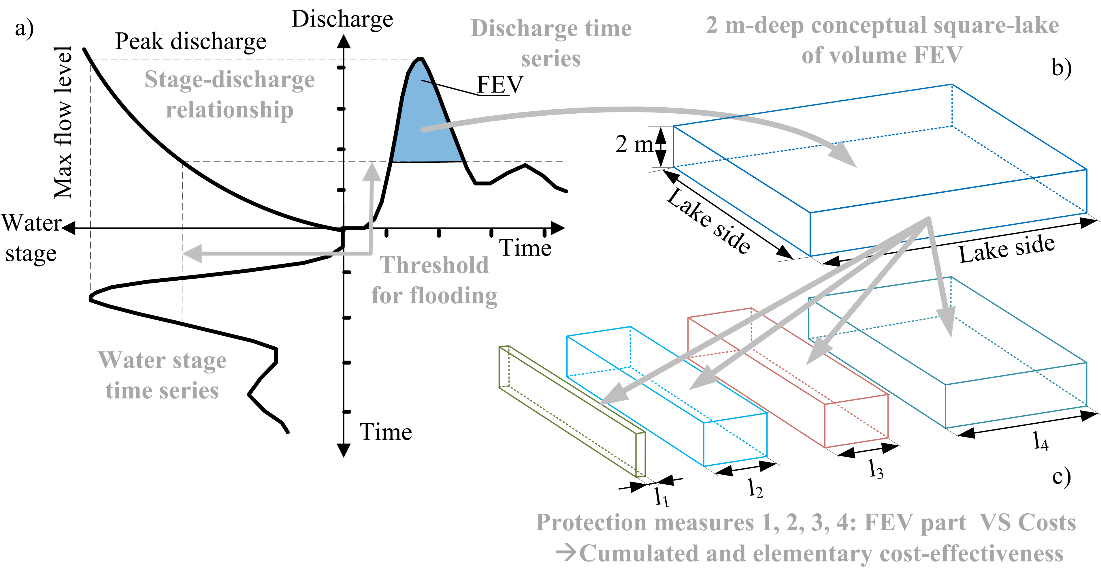
We offer a straightforward and educational protocol, for quantified flood-mitigation assessment of protection strategies, targeted for effectiveness analysis and decision-making involving stakeholder participation. It is based on the concept of flood-excess volume (FEV), i.e., volume exceeding a threshold and generating flood damage, and exemplified for recent extreme-flood events in the UK and France. The central questions are: what fraction of FEV is reduced, and at what cost, by particular flood-mitigation measures?
Quantification and interpretation of cost scenarios are facilitated using a novel visualisation of flood-alleviation basins as partially filled, 2m-deep square lakes with side-lengths of ~1-2 km.
In the scientific papers presenting this method, examples are provided based on floods experienced in 2015 on the River Calder in Mytholmroyd (Yorkshire, UK), River Aire in Leeds (Yorkshire, UK) and the River Brague in Biot (Alpes-Maritimes, France). They could be implemented on the platform as example. Each case has different flood-mitigation measures: flow-attenuation features, tree planting and peat restoration, and reservoir storage (Calder); flood-walls, natural flood management, giving-room-to-the-river, beavers, flood basins (Aire), and; retention measures, flood-walls, and bed-widening (Brague). Our straightforward protocol enables fast, quantifiable and easy to understand exploration of protection strategies using multiple measures, and in doing so highlights the issue of NBS scalability.
The codes could be transferred so that users providing (i) flood hydrograph and (ii) ideas of mitigations measures to implement (types, size, costs), could perform the analysis online.
The figure below synthetizes the essence of the method.
The Brague application is synthesised in the following figure:
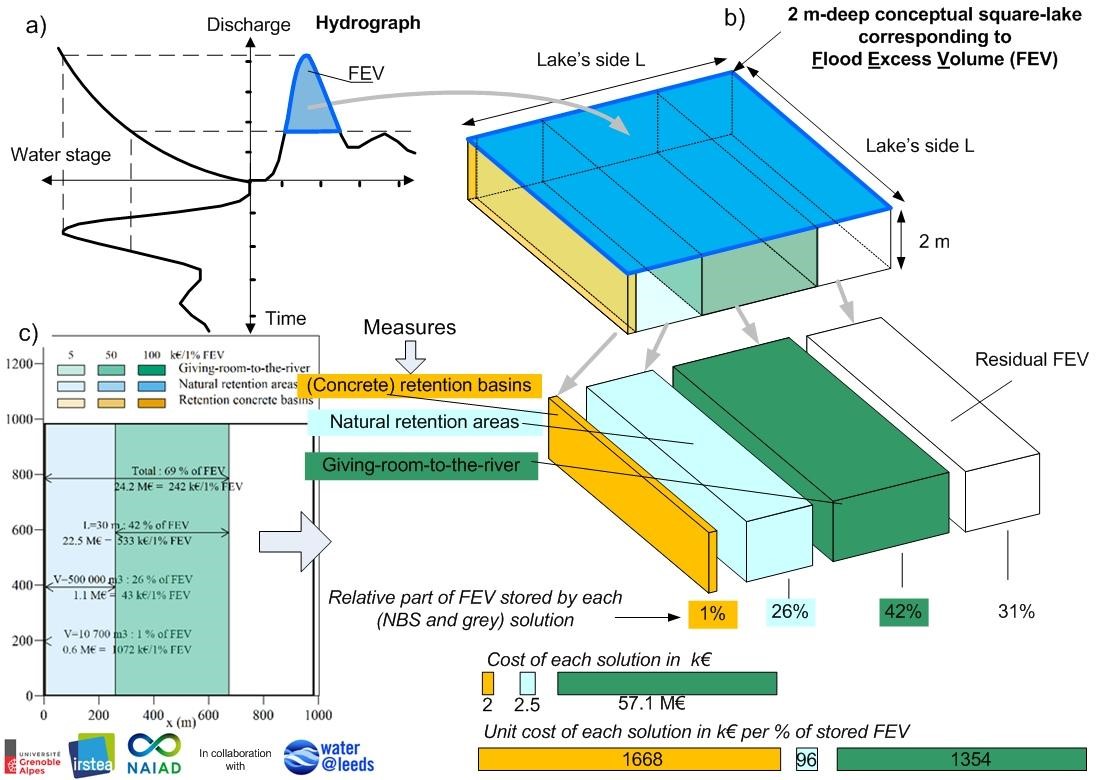
The flood excess volume of the Oct. 2015 at Antibes is about 1.9 Mm3. Which is the equivalent to a lake, 2m deep, square with a side of about 1000 m. This volume is split in three measures: retention basins (1% – 0.6M€), natural retention areas (26% – 1.1 M€) and giving room to the river (42% – 22. 5 residual 31% would still trigger flooding which is acceptable because the return period of the event approach 500 years.
Applications to decision making in the insurance sector:
Not clear, rather oriented to decision makers.
Added value of this modelling approach/model/results:
Fast and straightforward screening of mitigations measures strategies regarding efficacy of protection of each measures and of the full strategy.
What decision can be improved with this modelling approach:
Fast checking of protection strategy suitability.

Potential Categories of Users
Consulting companies, river and city managers, citizens
Additional Links
● Bokhove O., Kelmanson M.A., Kent T., Piton G., Tacnet JM. 2019. Communicating (nature-based) flood-mitigation schemes using flood-excess volume. River Research and Applications 35 : 1402–1414. https://onlinelibrary.wiley.com/doi/full/10.1002/rra.3507
● Bokhove O., Kelmanson M.A., Kent T., Piton G., Tacnet JM. 2020. A Cost-Effectiveness Protocol for Flood-Mitigation Plans Based on Leeds’ Boxing Day 2015 Floods. Water 12 : 1–30. https://www.mdpi.com/2073-4441/12/3/652/xml
● Piton G, Tacnet J-M. 2020. Risque d’inondation dans le bassin de la Brague (Alpes-Maritimes): ré-analyse de l’évènement d’Octobre 2015 à l’aide de la méthode du FEV. Technical note. [online] Available from: https://hal.archives-ouvertes.fr/hal-02866215
● Bokhove, O., Kelmanson, M., Kent, T., Piton, G. & Tacnet JM., 2019: “Using flood-excess volume to assess and communicate flood-mitigation schemes”, in : Geophysical Research Abstracts – EGU General Assembly
● Bokhove, O., Kelmanson, M., Kent, T., Piton, G. & Tacnet JM., 2018 “Using ‘flood-excess volume’ to assess and Communicate flood-mitigation schemes”, in Evidence Based Decisions for UK Landscapes – Rural and Urban Land use, Coastal and Inland Waters, 17-18 September 2018, Isaac Newton Institute, Cambridge, United Kingdom
● Bokhove, O., Kelmanson, M. and Kent, T. (2018a) On using flood-excess volume in flood mitigation, exemplified for the River Aire Boxing Day Flood of 2015. URL: eartharxiv:org/stc7r.
● Bokhove, O., Kelmanson, M. and Kent, T. (2018b) On using flood-excess volume to assess natural flood management, exemplified for extreme 2007 and 2015 floods in Yorkshire. URL: eartharxiv:org/87z6w
Also See source codes: https://github.com/Flood-Excess-Volume